


Stephen Webb has transformed leak detection and network efficiency at Greenville Water Utility with the help of Qatium’s water management platform.
Qatium builds confidence in my team that they can get complicated, overwhelming situations under control—fast.
Stephen Webb, Superintendent at Greenville Water Utility
The Greenville Water Utility in Indiana uses Qatium to run water planning scenarios to better serve their customers. When a recent increase in base consumption made Superintendent Stephen Webb suspect a leak, he used the platform to narrow down the search area and fix the issue—in a fraction of the time it would’ve taken him in the past.
Greenville’s water network at a glance
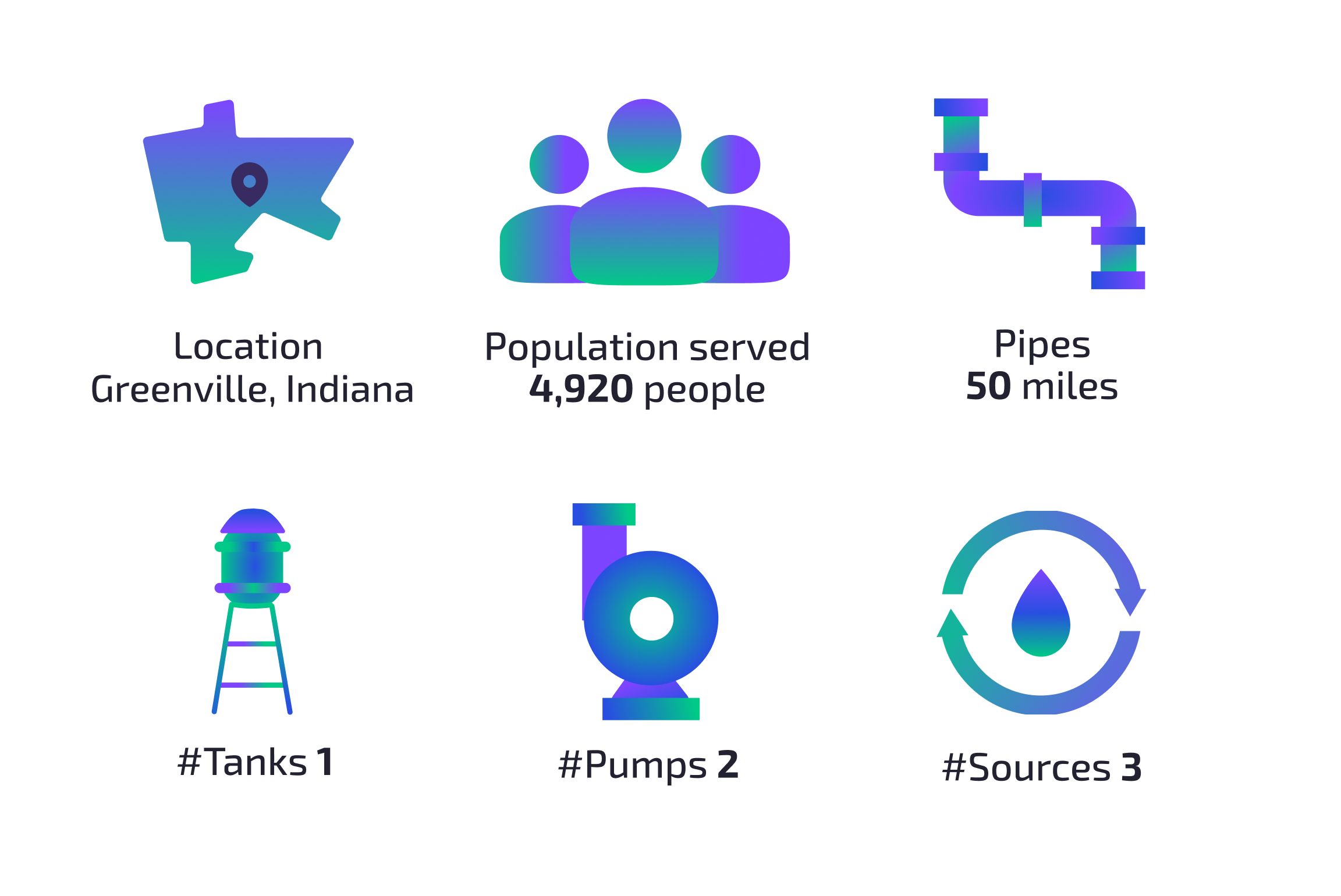
Greenville uses several data and technology types to manage their water system, including SCADA and smart meters. Thirty-five per cent of customers have switched over to smart meters since 2021, which Stephen hopes will grow to 50%–60% in the near future.
Leak detection and water scarcity
In Indiana, water scarcity is a significant issue, particularly in regions where population growth, agricultural demands, and climate change put pressure on water resources. Greenville is not immune to weather fluctuations, drought, and low rainfall levels. Stephen and his team have to ask customers to conserve water, and always keep a cautious eye on how much water they purchase from other utilities in times of increased need. Additionally, their original water main and a few hydrants are from the 1960’s—contributing to the risk of leaks.
Reducing water loss due to leaks is a key way to address water scarcity. Before they started using Qatium, an estimated 25%–28% of Greenville’s water was lost due to leakages. Now that number has reduced to 15%–18% thanks to their ability to narrow down the location of potential leaks.
Isolating a leak area with Qatium
In a recent period of increased daily consumption, Stephen and his team suspected an 80-100 gallon/minute leak, but couldn’t easily identify where it was happening. The problem? Without any customers calling it in, there was no way to pinpoint its location, even broadly.
So Stephen went into Qatium and narrowed down the leak location by targeting different sections related to the increase in demand, using Qatium’s Demand Spike plugin. By process of elimination, he narrowed down the potential leak location by 20%–25% in one pressure zone—a remarkable achievement considering some data around live consumption and SCADA data was not yet connected to the platform.
Qatium is very user friendly. We just went in, used the Demand Spike plugin, and targeted different sections. We tested scenarios by adding the leakage to customer meters, and identified the leak.
Stephen Webb, Superintendent, Greenville Water Utility
Once they located and investigated the leak, they found that it had been bedded down in some rock and was following a ditch line into a pond. Without Qatium, Stephen said, it would have taken another day or two for the leak to saturate the ground for it to be seen and mitigated.
Leaks are not easy to find. Sometimes you get lucky with a big enough leak—you know what areas are hit and where to look. But sometimes you just have no clue.
Stephen Webb, Superintendent, Greenville Water Utility
Proactive network management
In the case of a suspected leak in the future, Qatium will allow Stephen and his team to click on a potentially leaking main, identify which valves to shut down, and ignore the ones that are inoperable. It can pinpoint affected streets and customers, enabling the team to mitigate risks such as turbidity and spikes or troughs in pressure. All of this is possible through Qatium’s easy-to-use network visualization.
Future plans for enhanced data integration
Going forward, Greenville is looking to increase the number of smart meters from 35% to 60% of network coverage. Increasing the AMI data will provide better consumption information, making modeling more efficient—especially when it comes to understanding demand times. They are also looking to implement more pressure sensors to give them more accuracy when it comes to leakage detection and early warnings.
A commitment to learning and innovation
Stephen Webb’s passion is evident. He and his team are dedicated to learning, training, and staying on top of the industry. With the Qatium platform, they can extract more value from the work they do with hydraulic modeling consultants.
Qatium: a holistic approach to network management
If your system isn’t used to these kinds of workflows, worry not—Qatium is designed to work from any starting point, letting you update an existing model or build one from scratch with GIS data alone. Qatium’s model builder can work with a limited GIS dataset, analyzing and creating a hydraulic model of your water network. If you already have an existing model, you can leverage it—and complement it with extra GIS data and live data to create an operational model.
Are you a water utility seeking to eliminate guesswork and enhance your network’s efficiency? Explore Qatium’s water management platform to improve leak detection, better understand your system, and improve services to your community.