


Connecting tech for the greater good: overcoming fears about open data in the water sector

1st January 1970
 Qatium
Qatium
Qatium
Solving water is never going to be achieved by one mechanism or one company. Water is inherently part of a complex, collaborative ecosystem, and it’s becoming ever more urgent that we humans mirror that collaborative complexity in our efforts to solve water challenges. We need to bring together diverse, clever minds, to collaborate, innovate, and solve the critical water challenges of our time. Open data in the water sector will be key to this.
But the water sector has legitimate fears it must overcome in order to become more open and successfully enter the open data ecosystem. The water industry needs appropriate, fit-for-purpose, secure technology that helps companies share between each other as well as with the general public.
But there’s also a need to change the narrative around water, especially in the UK where bad press can be a particularly heavy burden, so water companies feel more empowered to open up and do the hard work of standardization and interoperability, in order to extend water knowledge beyond their boundaries for greater good.
Microsoft has ambitious water sustainability targets. Our environmental, social, and corporate governance (ESG) goals include our commitment to being water positive (replenishing more water than we use) by 2030. We’re implementing a number of key actions to better manage water across our own operations. But we also view scaling water solutions through innovation and digitization as a key pillar in our journey to water positivity. We recognize the importance of open, collaborative data, systems, and partnerships in magnifying our own positive impact on water sustainability.
In the UK specifically, Microsoft hosted the first ever UK Water Open Data Forum, alongside Stream, the Open Data Institute, and Ofwat, for the purpose of building an Open Data Roadmap (the first draft is currently under consultation) for the water sector. The Open Data Roadmap outlines the activities and outputs the UK water sector needs to collectively act upon in order to generate maximum value from open water data while at the same time minimizing any risks and harms from open data publication.
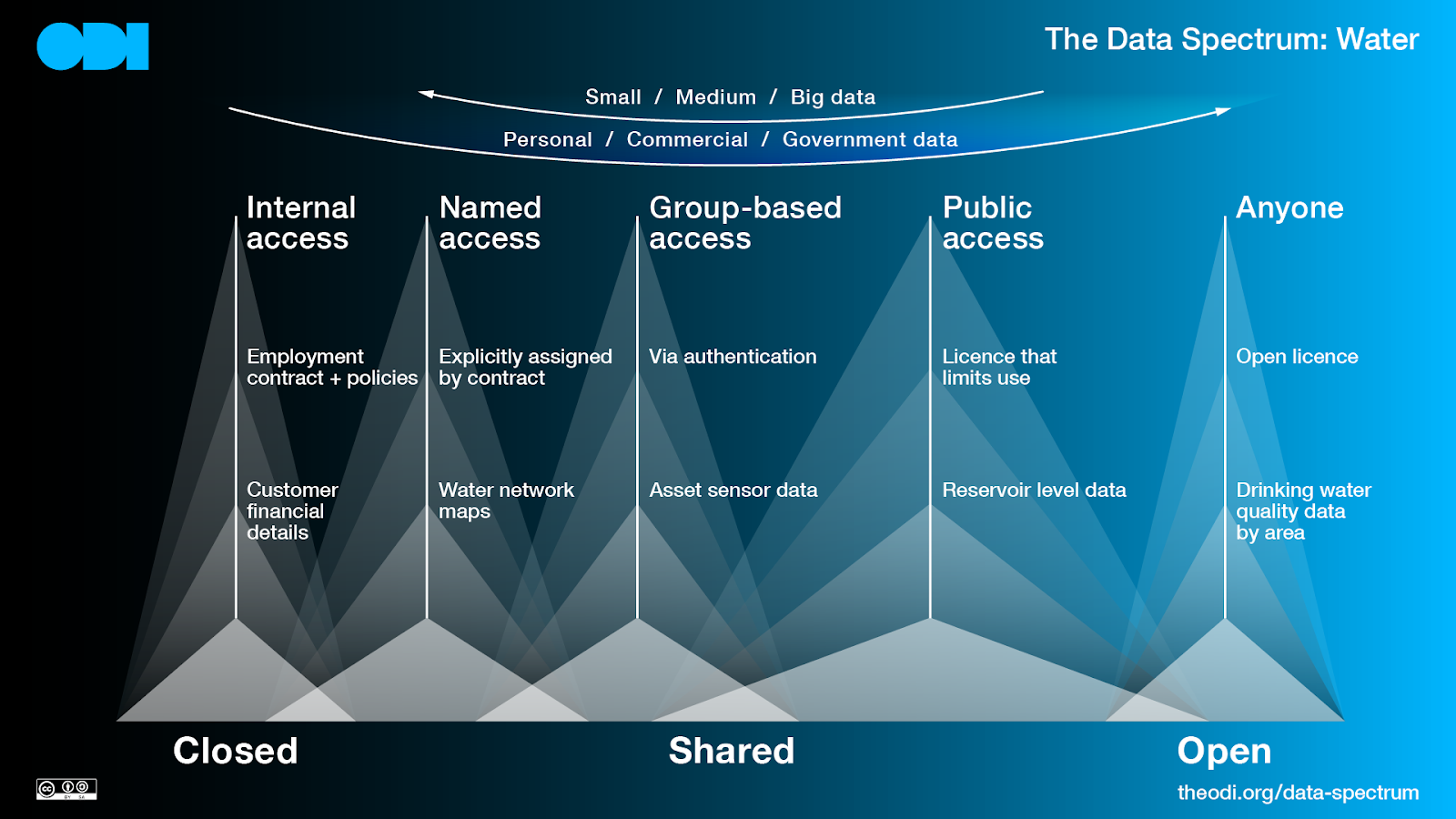
Regulators are putting pressure on UK water companies to be more open with their data, but data openness falls on a spectrum. There are certain kinds of data that would never be made available to the public, such as data related to commercial confidentiality, intellectual property, people’s privacy, or national security. Nevertheless, there may be value in sharing between water organizations in a trusted environment (and eventually even a requirement to), and that means making it easier for water companies to not only share data with the public (the most open side of the data spectrum) but also keep certain data safely shared between water organizations when needed (the middle of the data spectrum).
There are a myriad of ways data access and sharing can be facilitated. The water sector must leverage the right technology for interoperability, so it can effectively, securely, and easily manage its full spectrum of data sharing needs. This may look like decentralized and centralized sharing, where centralized data is stored in a central repository and decentralized data is hosted by individual companies with mechanisms that allow sharing in between them and to the public.
The tricky part is, most companies and organizations in the water sector already have some kind of internal enterprise data platforms for internal purposes, so facilitating secure interoperability between organizations will require the right kinds of technology partners.
It’s important to remember, though, how much interoperability in the context of open data initiatives is a human problem, not a technology problem. Because if you want to interoperate and share more, you have to standardize the underlying data. This is part of what Stream aims to address, and it’s where the water industry struggles a bit, because there’s such a mix of operational technology, language for how knowledge is represented, and vagaries of individual networks that affect data collection and outcomes. Companies worry about comparing an apple with a pear and people drawing conclusions without understanding nuances in data from different sources.
Relatedly, the sector fears open data leading to bad press and reputational or financial penalization. How will the public react to political and journalistic debate about what the water companies do and how they work and the history of how they’ve operated as private companies that have monopoly positions? These concerns can make some water companies hesitant to engage in open data processes.
In the UK, water companies face competing pressures from different regulators, private and public, that make opening up difficult. Stakeholders put pressure on water companies to make a profit. Ofwat puts pressure on water companies to ensure water operations and water products are as cheap as possible for the benefit of the public. The Environmental Agency (EA) puts pressure on environmental standards, requiring companies to invest in tracking the environment. The Drinking Water Inspectorate (DWI) drives pressures around the UK’s water being the cleanest, purest, least chemically-treated water on Earth. Finally, the taxpaying public exert their interests, which can be heavily influenced by negative press in the UK.
There isn’t yet a virtuous data sharing cycle in the water industry, where when water data is shared, the social environment is hospitable to it and it’s adopted into a collective spirit of collaboration, openness, and innovation, in turn generating new knowledge to be shared and built upon. Instead, when data is released, it can often lead to negative stories in the press and penalization of different sorts. This has historically led to the water sector being quite gun shy about sharing information.
The antidote, I think, is for the water sector to own the narrative and communicate the bigger picture in the face of criticism. The water sector can leverage its openness as an opportunity to shift perspectives and educate the public on the value of water, where it comes from, how it gets to their taps, and the many adjacent industries that have an impact on it, so the public can understand the big picture and combat negative press. Because the reality is, there’s no easy fix to the less-than-ideal ways our society has historically invested in and managed our water systems and the current problems we may now face because of that.
But even if we had the best, water-tight systems in the world, the UK is still using too much water per capita per person to sustain our aquifers and rivers. So it’s about owning that narrative: the data and the history isn’t perfect, but we’re taking these positive steps to open up and bring together collective knowledge. We’re engaging the public with transparency, and it’s an invitation not to sit on the sidelines in anger but to get involved and help us come up with solutions to these really difficult problems that are ultimately ecosystem challenges, which are everyone’s responsibility.
It’ll be a bumpy road. But the thing is, every water organization in the UK, commercial or otherwise, wants to do the right thing. Protecting water and the environment is like a vocation for the people who end up working in these organizations. So the water sector has the benefit of having the best people all trying to do the right thing for water, and there’s a lot of good news to share. It’s not like, for example, the tobacco industry whose incentive may be to keep the amount of negative press they get down. Water companies can share their positive stories about all the great work they do that show they are stewards of the environment.
When it comes to open data in the water sector, there’s no sense reinventing the wheel; there are many open data projects that lead the way and have shown the benefits. Stream is following in the footsteps of UK Power Networks, whose own open data portal has led to people using the open energy data to develop products and services, even entirely new start up businesses, built on the back of the fact there’s open energy data. Transportation For London’s (TFL) free open data was estimated to generate annual economic benefits and savings of up to £130m a year. Other sectors have seen huge amounts of innovation because of open data. You can even look to NASA’s Hubble Space Telescope: all Hubble data becomes non-proprietary after six months, and its archive can be freely accessed by anyone. This is an amazing example of how people can derive new value and ecosystems around what’s often a static dataset, as long as it’s an open one.
Not only is water an ecosystem problem, it’s also a global problem, and global problems need global solutions. Open data has the power to lead the way, but someone needs to take the macro view. Microsoft is doing something that is much like what the UK water industry is doing with their open data initiative, only from a global perspective. Microsoft’s Planetary Computer combines petabytes of open datasets of global environmental data. Imagine the large-scale challenges that could potentially be solved as water sectors around the world build open data ecosystems that could then flow into a macro view of the planet. The time is now for all sectors to contribute to open data ecosystems, so openness and innovation is at the helm of sustainability across the globe.
This article was taken from Qatium’s whitepaper “Open Water: why we need open data, open software, & open collaboration in the water sector.” You’ll find the full whitepaper here.
Open Water 2.0:
Open platforms, Marketplaces & Community
Open Water 2.0 builds on the foundation of our first Open Water whitepaper, which explored the value of open data, open-source software, and open collaboration in the water sector. In this paper, we introduce three new critical drivers to the Open Water approach: Open platforms, Digital marketplaces and Communities in motion.

Your cart is currently empty, go to the Marketplace to shop plugins
View MarketplaceTax and fees added at checkout


